Thursday, 16 May 2013

Marrakech - A Journey to the Red City

I was feeling a little restless in Valencia recently; it rained for a few days solid and I was obviously outraged. The chance of a spontaneous trip to Marrakech came at just the right time. As I was the only one of our group without copious amounts of work to do, I wound myself up researching the city in the few days between deciding to go and getting on the plane. My head was filled with tales of the various tourist scams, street harassment (all three of us were girls) and aggressive market sellers.
As soon as we got off the plane we were hit by the heat - at 20h local time it wasn't oppressive, but it did add to our fatigue and it would have had pink Brits scorching themselves on roundabouts in England. In front of the airport was the most beautiful smoking shelter I've ever seen - a black wrought-iron gazebo, and a whole host of taxi drivers waiting to rip us off.

My advice for the first couple of days there would be not to buy anything. You're especially vulnerable when you haven't got used to the currency or the usual prices of things, and they are very good at swizzling tourists. Morocco's main source of income is tourism and they have had centuries to fine-tune their haggling skills. Even with my WikiTravel print-out and knowing that a taxi ride into town costs the locals 20 dirham (2 euros) and 50 is a good price for tourists, we almost agreed to share a taxi with some Swedish girls for 30 dirham each. That's 15 euros for about a 10 minute ride.

Luckily, the express bus came at 22h (the schedule stopped at 21h30) and dropped us off at the main square. We then had to navigate our way to the hostel in the dark, through throngs of people, using the bare instructions we had been given.
Place Djemaa El-Fna at night. Dodgy camera phone shot.
I'd seen Marrakech described a number of times as an 'assault on the senses'. I wouldn't go that far, but it was disconcerting and incredibly exciting to be suddenly plunged into such a different culture, particularly at night and with no idea where anything was. The square was lit up by the food stalls and we dodged caleches, locals selling trinkets and henna, donkey carts and many, many motorbikes. Snake charmers' music flooded the square and we were distracted by the shouts of the orange juice sellers and the smells of roasted meat, spices and tagines. I was struck by seeing a woman in a niqab and gloves mount a motorcycle with a baby on her back and accelerate away through a crowd of people.

Eventually we asked a shop owner to point us out the café that should have served as a landmark in the square. It turned out we didn't see it because it was covered with a big white sheet that we assumed was for building works. Later we discovered it was the site of the Marrakech bombing in 2011. Nevertheless, Marrakech is considered completely safe to travel to, and it felt that way. 
We expected to schlep straight to bed when we got to our hostel, but we were given mint tea and cake instead. We were always given free tea whenever we wanted there, so I was drinking almost as much as I do in England. The hostel staff at Waka Waka went out of their way to make us comfortable, coming to find us all the time to bring us tea and answer all our questions about Arabic, Morocco and their lives. 
On the last night, the guys dressed in their djellabas so we could take photos and taught us to make mint tea. Abdessamad had forgotten it was his birthday until his mother called him and was very apologetic that he hadn't cooked us anything. We had tea and cake together and he told us all about his life philosophy - don't smoke or drink, be nice to people, don't worry about money, work hard for your family.
We took the first couple of days to wander around the souks - the labyrinth-like markets - and go to a traditional hammam. It was 1 euro to go in and 5 euros for the gommage (scrub), which was totally worth it. We followed two women (only one francophone) in, in just our bikini bottoms and were exfoliated hard with the gloves and black soap that we'd bought. It's good to do this on the first day because it took off all of our tan, and then made it easier to tan during the rest of the trip. 

There's no room for body issues or British squeamishness in these baths and I was really glad I'd spent two hours last term wandering around a Russian banya naked. The women scrubbing you don't care if your hand keeps banging against their breast, they rest your leg on their upper thigh to scrub you better and are prone to pulling your bikini bottoms down unexpectedly and then hiding them. To be honest, I don't see why it's traditional to wear anything at all since they scrub you *everywhere* anyway, or why I had a bucket of water emptied over my head ten times in a minute, but who am I to question their ways? It was hilarious and strange and extremely refreshing, as well as a great insight into one aspect of Moroccan life.
Koutoubia mosque
Saidian tombs
Badi Palace - rare photo with no storks
Rabbi's house - the Jewish quarter
It's impossible not to take everything at a slow pace in Marrakech. The locals famously step out to post a letter and spend the whole day having tea and cous cous with anyone that they run into on the way. We took a day to do some very relaxed sight-seeing and get lost. The only disappointment was that we tried to go to the Jewish cemetery on Shabbat, which was obviously closed. A local teenager heard me (very shakily) reading the Hebrew letters on the sign and offered to show us around the Jewish quarter. Although it had all the makings of a tour guide scam, he was lovely and just wanted to practise his English, and although he showed us his friend's shop before leaving us, there was no pressure on us to buy anything. Apart from the Rabbi's house, nothing in the area seemed very Jewish and my bagel lust went unsatisfied. Our guide told us most of the Jewish families had moved to Israel, which I can completely understand.
By Sunday, we were desperate for a swimming pool. Unfortunately we mixed up a swimming pool with a fountain called 'le Jardin des Jeunes' and ended up walking almost to the airport in the baking midday sun. However, some Moroccan boys who were walking just ahead of us ran and picked us a rose. We got some lunch and went back to our hostel to sunbathe on the terrace. The one weird point of the trip was a kid who was peeking at us from the neighbouring roof and his adult male relative who stood openly staring at us and smiling. We covered up but it was only when we asked him, 'Do you want something?' that he went out of sight, only to return about half an hour later. The next day, the kid came back and we sent Hossein to tell him off. 

Other than that, I honestly think I experience more street harassment in Spain or England than in Marrakech. Granted, we only went out in the night on two occasions, one of those with a boy, and I obviously wouldn't understand any Arabic slurs that might be whispered behind our backs. But the cries of 'gazelle!' or 'beautiful eyes!' just feel like a joke that you're in on, rather than a jeer or insult to make you feel embarrassed and laugh at you. The men doing this will look you in the eyes and appreciate a few words of Arabic, which seems like a fair trade considering we heard: 'Charlie's Angels! Hey Charlie, get me the angels!'; 'lovely jubbly!' and 'shufty, shufty?' I also got called Jennifer Lopez at one point (it's those fatty breakfasts) and we heard Lady Gaga, as well as Harry Potter - directed at a girl with round glasses.
At no point was I able to finish this. Cake??
A nice Australian we'd befriended at the hostel suggested we go on a day trip somewhere. We'd already had the Waterfalls of Ouzoud in mind and after a bit more haggling, we signed up for the Monday. The Brazilians from our hostel and an American group of various Middle Eastern and North African descent accompanied us there. As we were driving through the Moroccan countryside looking at the large purple mountains, Berber villages and trying not to throw up (a bumpy minibus ride is not what you want after a sugary breakfast and minimal sleep), we got a proper look at a more authentic side of the country and I felt some wanderlust creeping on.
Cobweb falls
The falls we swam in
Rainbow!
Our lovely guide Mahmoud
The waterfalls were so beautiful, with a very steep drop. Mahmoud kept warning us to be careful and stay away from the edge, which we largely ignored until he pointed out all the places where people had died:

'Over there, a girl 3 weeks ago...right here, a boy 2 months ago, I was at the bottom, I saw him hit the ground...'

After that, whenever he encouraged us to take pictures from a certain spot, we stayed well away from the edge. I didn't feel like falling to my death or standing where anyone had passed their final moments. 

Mahmoud, who spoke excellent English, French and Spanish, and had been stung by a scorpion in his house at 23h the night before and gone to hospital, showed us olive trees that were 950 years old (50 years away from dying), petrified rock that used to be tree roots, turtles, ancient Berber caves, and how not to die as we navigated the valley. He also pointed out the best places to take photographs and kept us laughing along the way:

'Britain...lovely jubbly! Marmite! Fish and chips! The Queen!'

Yep, that's everything in England! 
Listening to a storyteller
Snails
Whole/half/quarter of a sheep's head?
In the evening, we went to get dinner at one of the food stalls that pop up in the square at night. Each one has several greeters around it who try everything to get you to eat with them. We stopped to try some snails first, which were in a spicy broth and actually really good, even though their eye stalks are definitely visible on the way into your mouth.

The greeters are really charismatic and clearly appreciate it if you joke around with them. One popular joke was, 'Oh, you're from London? I'm from Wigan/Ipswich!' I told them I could hear the accent. One greeter told me that everyone in the stalls knows each other and it's just a massive game to see who can get the most people to their stall. As we stood deciding, we were surrounded by greeters promising us free drinks and olives, as the cooks in the stalls shouted and cheered. When we eventually sat down it was to pantomime-like clapping and booing. 
Caroline the chameleon
 On our final day, we headed out to tackle the souks. Having spent days practising our Arabic, researching what we wanted to buy and how much to pay for it, we were in prime haggling mode. Between us we got a teapot, some saffron, some Berber lipstick, Moroccan eyeliner (that men and women wear for its disinfecting properties in the desert), some jasmine and musk, a beautiful hand-stitched leather bag, some jewellery and a fragrant, carved box made of juniper. As we left all sellers looking unhappy, we felt pretty pleased with ourselves.
Marrakech was an entertaining, welcoming and lively window onto North Africa and Islamic culture, both of which I know next to nothing about, aside from a day-trip to Tangiers several years ago. I saw women in hijabs driving men around on motorbikes, taxi drivers held apart by their friends as they screamed at each other only to be hugging and explaining a few minutes later, Moroccans playing all kinds of games with the gullible tourists and sitting down to tea with the friendly ones. I could see exactly why Moroccan hospitality is so infamous and I wish we had time to travel to Fez, Essaouira, Casablanca...luckily we were invited to stay in our new friend's house if we're ever in Agadir, to watch his mother make argan oil. Bless.

Wednesday, 10 April 2013

The Verb 'To Be' In Different Languages


Arguably the most essential if not important verb in the English language, the variations of the verb 'to be' in other languages can indicate how the speakers think; in other words, how foreigners value and define existence or 'being'. Whether it's language that influences culture, or the other way round, I attempted to draw some likely conclusions about where we differ from other nations.


Russian: быть/есть
Although the main verb Russians use for 'to be' (быть) has a past and future tense, the Russian language famously has no present tense for the verb 'to be'. Instead, pronouns and adjectives go directly together:

Я студент - Ya studyent - I am a student

The verb 'есть', which means 'to be/to eat' is used to mean 'there is/there are', like the Spanish 'hay':

Там есть три девушки - Tam est' tri devushki - There are three girls

Additionally, instead of saying 'I have', using the verb 'иметь', you say 'to me there is':

У меня есть мечта - U menya est' mechta - I have a dream

It's interesting that there is an association in Russian between being and eating, especially for a country not known for its cuisine, although perhaps the link is the need to eat for survival. There is also less of a sense of direct ownership of an object or, as in the above example, product of your mind. The language implies that it exists independently and uses the object of the sentence, whoever the person may be, as a medium. The fact that 'быть' lacks a present tense means that a person or thing can be defined entirely by an adjective, or noun like their occupation. All of these linguistic aspects are particularly interesting considering the influence on or of the Soviet Union - increased susceptibility to Communism or a lingering effect of it?

Spanish: ser/estar
Similar to Italian (stare/essere); Portuguese (ser/estar); Catalan (ser~sser/estar)

The Spanish language differentiates between two types of being, largely between the permanent 'ser' and the temporary 'estar':

Ser

  • Elements relevant to identity: physical features (animate and inanimate things), personality, nationality, race, religion, gender, profession, origin, material - Soy inglesa (I am English) 
  • Possession - Es la mía (It's mine) 
  • Events or dates: days, months, years, festivals, parties, lessons etc - Hoy es lunes (Today is Monday)
Estar
  • States of being: emotions, physical appearance or condition (health), marital status - Estoy triste (I am sad) 
  • Location of things, buildings, people: La universidad está aquí (The university is here). 
  • With a gerund: Estoy leyendo/jugando/creciendo (I am reading/playing/growing) 
To an English speaker, it can be surprising to hear that Latin languages see things that we would usually consider to be permanent, like marriage and the site of buildings, to be temporary states of being, especially since divorce contravenes the main religion of a lot of the countries where these languages are spoken. Nevertheless, perhaps seeing marriage as a civil state rather than an aspect of your character is a good thing.

There are some phrases in which you can use 'ser' or 'estar' to alter the meaning of the sentence, eg. with 'gorde' (fat). 'Soy gordo' is a permanent physical description, whereas 'Estoy gordo' implies putting on weight temporarily, such as after Christmas. If only English had such tactful devices, perhaps we wouldn't have to be so deliberately polite all the time.

Mandarin:是
There are two verbs for 'to be' in Mandarin: '是' (shi - neutral tone), which suggests a relationship of identity (I am a doctor); '在' (zài - fourth tone), which indicates location. Mandarin has four tones:

1: Level Tone (ping) –> –
2: Rising Tone (shang) –> /
3: Departing Tone (qu) –> V
4: Entering/Stop-Final Tone (ru) –> \

This means it's easy to confuse the verb 'shi' with '吃' (chī), which means 'to eat'. If you're a real newcomer to Mandarin, you can also confuse it with '說' (shuo), 'to speak'. These are clearly different to native speakers, but it's nice to think that being, eating and speaking came from the same root.

Obviously, Chinese is a pictoral language and functions differently to Japanese in that every word has a different character, composed of elements associated with the destination word. For example, the word for bank '銀行' is composed of two words:
銀 (yín) – silver
行 (háng) – all right; capable; competent; ok; okay; to go; to do; to travel; temporary; to walk.

**For anyone interested, there are some beautiful descriptions of the imagery in Chinese characters in Chinese Cinderella.**

Rather than reading in the widespread sense of decoding letters to make a word in your head, the Chinese are given a pictoral representation. In this case, 'bank' has connotations of money and security - a far cry from its contemporary associations in the West.

Gramatically, Mandarin functions in a similar way: infinitives do not conjugate, but are placed next to words that infer a tense (jiang = future tense). However, a simpler way to change tense is just to use adverbs of time like 昨天 (zuótiān - yesterday). I really like that infinitives are unmodified and kept separate from words that convey the specific meaning. Chinese speakers must have a greater sense of actions - eat, pray, love (ha), speak, be - going on forever through generations, indifferent and essentially the same.

Hebrew: להיות
Like other Semitic languages (Arabic is the big one), Hebrew does not have a verb 'to be' in the present tense, although it declines in other tenses. One theory about the tetragrammaton YHVH, used to refer to God in Hebrew, is that it is a combination of these three words:

היה Haya- was
הוא Hove- is
יהיה Yihiye- will be

This gives the name for God an eternal quality; it is often translated in the Bible as 'I am the one who Is, Has Been, Will Be'. It's not really surprising that for Semitic languages, God is associated with the highest form of being, or that the present "being" of earthly things was unimportant. See Communist Russia for how this kind of thinking can go very wrong.

Turkish
The verb 'to be' doesn't exist in the Turkish language. Instead, suffixes are added to nouns, adjectives and adverbs to give the meanings of 'I am, they are, you were' etc:

bir vazodur - it is a vase.
bir vazoydu - it was a vase. 

Türk'türler - they are Turkish.
Türk'tüler - they were Turkish.

There is also a verb 'olmak' which means primarily:

'to become, to exist, to come into being'
secondarily:
'to happen, to occur, to take place'
and thirdly:
'to be' (to have/fill a position/place or to show [...] characteristic)

Although it can appear in infinitives as an auxiliary verb, ie 'Kel olmak' (to be bald), it's only conjugated in a few situations of "occurence":

What happened? - Ne oldu
What is happening? - ne oluyor
Maybe for Turkish speakers, existence is so obvious it doesn't need to be stressed?

Japanese
Japanese has different versions of 'to be' depending on the status of the subject. 'ある' (aru) is used for inanimate objects and plants while 'いる' (iru) is used for animals and humans. There are also copula verbs "da (だ)"/"desu (です) that translate as 'are/is/were' etc. I read about a very polite form used for an unknown person or someone with a higher status, but I couldn't find anything more specific. However, the fact that even Japanese grammar discerns between higher and lower being as related to status is not that surprising considering how important status is to the culture. Google bowing, social norms and saving face in Japan for further insight.


Greenlandic
Greenlandic is in the Eskimo language family and can convey what would be entire sentences in most languages, in single words. It is a 'polysynthetic' language, which means words are made up of a root, a suffix and one or more affixes. Some irrelevant, but charming words in Greenlandic are: computer - 'qarasaasiaq' (artificial brain), and potato - 'naatsiiat' (something for which one waits for a long time to grow up). Adorable!

There are many ways to convey the verb 'to be' in Greenlandic:

ippoq - are (only used with qanoq, ima, taama, -/+mi (inessive), soorlu and -/+ tut (aekvalis). It often seems like an affix.

1 - Qanoq ippit? How are you?
2 - Imaappoq or taama ippoq It is like this (I now want to say or show)
3 - Taamaappa? or taama ippa? Is it like that? (you just said or showed)

Tassa - it is (introducing)

1 - Tassa illorput It is our house
2 - Ivalu tassa anaanaga Ivalu is my mother

-uvoq, +uvoq, -avoq, -juvoq: an affix for the characteristic of the mentioned object

1 - Illuuvoq It is a house
2 - Anaanaavoq She is a mother

-uvoq, tassa and +una do not mean the same thing:

1 - Nakorsaavoq She is a doctor
2 - Tassa nakorsaq It is a doctor, it is the doctor (she's coming now)
3 - Nakorsaruna It is a doctor, it is the doctor (that you can see or are talking about)

-gaa (-givaa), -raa (-rivaa) - have him to.., he/it is his
This affix expresses the characteristic of the mentioned object more than tassa does

1 - Illugaarput or illugivarput It is our house [We have it to house]
2 - Anaanagaara or anaanagivara She is my mother [I have her to mother]

+una (sing.), +uku (plural) - it is, is it?
Words with these affixes are written by adding "-" or by assimilation (like the pronunciation)

1 - Ujarak-una or ujaranguna It is a stone

I would guess that, not just specifically with the verb 'to be', speakers of Greenlandic have a greater sense of the unity of things or aspects that are inseparable from the whole. It is interesting how, rather than a conjugating verb 'to be', they have wholly different affixes that seem to change according to the relation of the subject to the speaker...but the language is so alien to me, it's hard to even speculate.

Esperanto: esti
Esperanto seemed like a good example to end with, both for being a deliberately constructed language and for having aspects of all common world languages. Its grammar is comparatively simple and verbs do not change form according to the subject: I am, he is, we are become mi estas, li estas, ni estas. Even in English, in which a lot of conjugations aren't affected by the subject, the verb to be is irregular. Obviously, Esperanto is constructed and hasn't had thousands of years of being spoken, which warps most other languages' commonly used verbs. 
*Disclaimer: I only speak two of the above languages and can shakily read the Hebrew alphabet. Any mistakes are the result of my faulty research! However, this was a labour of love.

Saturday, 6 April 2013

Why Britain Sucks at Learning Languages

Google 'British teenagers' as I just did, and you may find that they 'lead the world in their sexual activity' and that the girls are the 'biggest binge drinkers in Europe'. As a Brit, I wouldn't dispute any of that. But a recent survey has actually made me embarrassed for my country of birth: one that found that English teenagers are the worst in Europe at learning languages. 

We all knew it was bad, but seeing the evidence plastered across the Internet is like being tagged in a photo doing that stupid drunk thing you did that you hoped no one had seen. We as a nation have two choices: laugh it off and keep being stupid, or let this public shaming motivate us to be less moronic.

Languages aren't for everyone. I routinely embarrass myself trying to do simple arithmetic (mostly because I forget what I was doing and just multiply whatever numbers I have in my head) so I am a firm believer in the different types of intelligence. But the statistics show us doing much worse than we should be genetically predisposed to do. England has been invaded and influenced by so many invaders and their languages. Plus we can't all be scientists - and we're not - so why do we suck so much?

I have studied languages at school, college and university in England so I feel like I have a good insight into why standards are slipping and were low to begin with.
Outdated Imperialist Attitudes
Once, we had a British Empire. Countries were colonised, nations exploited, resources plundered. At the time Britain was feeling pretty puffed up about its empire being so pimpin', but now no one cares. And if they do, it's because they want its atrocities never to happen again. One of the vestiges of colonisation is the languages left by the invaders: English spoken in most of the red highlighted countries above, Spanish all over Latin America, French in parts of Africa and the Caribbean etc. 

In one way, it's incredibly useful that people from distant parts of the world have a higher chance of communication. However, British teenagers, in their bid to find something, anything, to counter their crippling lack of self-esteem, can forget that the reason most of the world speaks English now is because of the US, and brag about how they live in GREAT Britain. Or there's the whole 'we created America so we made them the country they are today' argument, otherwise known as 'Catholic parents who threw their Protestant kid out on the street want a cut of his present-day fortune'. But hey, anything to distract from acne.

The problem comes when they hear that they don't need to learn other languages because the rest of the world is learning English for them. This is especially destructive from parents, older siblings, anyone in a position of influence, and it's not even true! The image that kids hold of tanned restaurant and hotel owners, fluent in English, waiting for tourists outside their white-washed establishments might be true in Ibiza. Hell, most of the employees are English nationals. But for people who travel off the package-holiday path and towards, say, Paris, wildly pointing and shouting 'DO YOU SPEAK ENGLISH?' is not enough to elicit more than laughter or a blank stare. 

You at least want to be able to understand people as they mock you in their native tongue. Additionally, what kind of person takes pride in knowing less words than their peers? 
Teenagers hate trying
This should be big news, to no one. Languages don't come naturally to everyone, and even for the ones to whom they do, there are many complications, exceptions and inexplicable rules along the way. See this post about Russian language for reference. It can be incredibly frustrating, but incredibly rewarding when you crack the alien logic and hear yourself talking in strange tongues. 

Unfortunately for slackers, languages are an acquired skill. You can't doze through all your lessons, pull an all-nighter before your GCSE oral exam and expect to get an A because you need to slowly learn more grammar and more vocabulary and drill them into your head with practice. This doesn't have to be difficult; it's as simple as doing your homework and even reading the odd foreign article, listening to music or watching a film in the language you're learning. All fun and interesting activities, all types of passive learning. See, you don't even have to look like you're trying. I personally used to do grammar exercises to de-stress, but that's a level of geekdom you don't have to stretch to. There's no turning back after that, kids, before you know it you'll be living abroad, up to your elbows in Chekhov and Neruda in the original language and everyone will know you might be passionate about something. 
Dun dun dunnn
The English educational systemMost other European countries start teaching children languages as early as possible. Although this doesn't make everyone fluent, countries that value the importance of knowing foreign languages see a real result from this method, which makes sense as a person's receptiveness to a foreign language only decreases the older they get. In my primary school, we learnt a bit of French in Year 6 (ages 10-11), by which point most of the kids had mentally checked out and were busy proving how little they cared about school. 

Another bad aspect is the frequency with which students are examined. During the year they are hurried through curriculums, leaving little room for creativity, personal curiosity or the different levels of the group, as they are taught what they need to know to pass exams rather than to navigate a new country or inspire them with a fascinatingly different culture. I always liked languages but I thought I wanted to study English Literature until my French exchange in Year 10 where I realised all the opportunities of travel, new friendships and further interpreting that could be possible for me if I were to study languages. I even changed my mind about studying French and Spanish in my AS level year, applying for ab initio Russian; a decision that terrified and thrilled me. It's doubtful I'd have had the guts to do that without the support of my mother as well as passionate teachers who exhausted themselves trying to help everyone get the best possible experience, let alone final mark. Unfortunately, teachers are currently so overworked and underpaid, that this kind of determination is scarce and unsustainable and today's students lack the direction needed to convince them of the benefits of studying foreign languages. With the Arts budget cut by 80% and cutbacks being made to jobs and further funding in the public sector, this doesn't look set to change soon.
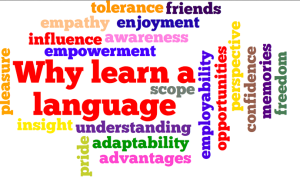
For any unconvinced teenagers who might stumble upon this, here are a few reasons to study a foreign language:

  • It's exotic: like the idea of telling people you speak the language of love?  Or travelled through remote parts of South America, speaking to the natives? Or that you speak Mandarin? You're a genius, who wouldn't want to go out with you.
  • Travel opportunities: Since the start of university, I've spent a month in Kazan', a weekend in Moscow, four months in St Petersburg, and I will have completed five months in Valencia along with trips to other parts of Spain, all purely for the good of my degree. What English lit students can say that? Speaking of which...
  • Variety of degree matter: my friends are often surprised at what we get to study as part of a language degree, but language is really just a different lens for the world (pretentious, but true). I've taken classes in Spanish and Russian cinema, Russian poetry, Russian short stories, the essays written after various Latin American countries became independent and the ensuing social development, legal translation, philosophy, short stories from France, Germany, Italy, China...not including the many I could have taken in history, etc. Obviously the sciences (bar philosophy, in Spain) are excluded from this wide scope but language students are lucky enough to get a taste of many different degrees, while increasing our language skills.
  • Language skills: this is the obvious one. The ability to speak a foreign language makes you much more employable and who doesn't want a job? I picked my languages not only because I had an overwhelming urge to learn them and immerse myself in the cultures linked to them, but because I covered a lot of global area by speaking them and they will make it easier to learn even more languages. French is the official language of the UN and has been incredibly helpful to me both with learning Russian and communicating with international students here in Valencia. Coupled with Spanish (I'm coming for you, Latin America!), I can already understand a lot of Portuguese and that is the next language I have my eye on. Russian helps me understand some of other Slavic languages, like Czech and Polish, and I'm currently using it to speak to my two Russian flatmates that I got completely by chance. The lunch-hour studying I did of Arabic and Mandarin for a year was not enough for me to remember more than a few words, but I'd love to return to them once I have a couple more languages under my belt. If like me, you love people, you'd be crazy to pass up the chance to chat knowleageably about different customs, dress, drinking traditions, weddings, funerals, work ethics...fascinating stuff that you can also pull out your sleeve if you have a foreign client at that job you have. Plus, it teaches you to really fine-tune your communication, verbal and non-verbal, so you can blitz presentations, reports, business lunches and not end up a sweaty, blabbering mess.
  • You can get published by a national student website.
  • You can live somewhere far away, like Santiago de Chile, or Tokyo!
  • Foreign liaisons: the economy is changing the way business functions. A third of US citizens speak Spanish. No longer is English the only language used to communicate internationally. Currently more people are learning German, Spanish, Russian, Norwegian even, so that they can move to find jobs. Even working in your own country, you could be an incredibly valuable asset if you can speak to clients in their own language, or for translating and interpreting purposes.
  • You become a much more well-rounded person. Conversations are never-ending if you can talk about films from Bollywood, Soviet Russia or Korea, literature from Nigeria, pre-revolutionary France or Franco's Spain. You hone your social skills and learn a lot of patience, with yourself and other people. Also, you'll be amazed how generous people can be. If you need your optimism renewed, take a trip somewhere. 
  • Life experience: even if you don't study a language, it's worth investigating if you can study your subject abroad for a semester. Living abroad forces you to be brave; you have to assert yourself, protect yourself and organise yourself in a foreign city, in a tongue that is not your own. Small things that might scare you in your home city like complaining about a meal or making a presentation at work will seem like a breeze after months of trying to communicate with people who may not understand a word you're saying, or coming to a new city with no friends and building a routine from scratch. It teaches you to seek out ways to squeeze the fun out of the city, to work hard at something you love to see the results you want and to appreciate what you have at the moment. You come into contact with a wealth of different cultures, from the natives and other international students; you can't get that kind of perspective without leaving your home turf. Although at times, it can be difficult, you really learn the value of having a good support system at home and away, and the break from your normal studies pushes you to work harder and travel more in the future.
Here are some to get started with.

Tuesday, 2 April 2013

Things Spain Could Improve

I love Spain. I would love to live here (oh wait...I DO). I took the above picture while I was sitting in my local park, which is in an old riverbed, doing some work by the water in a sundress. It was maybe a couple degrees warmer than England right now. Although my time in Spain may seem all sangría and sunbathing, I have been able to identify some things Spain would need to improve before I took up permanent residence. You hear me Rajoy? Sort it or I will do a Depardieu.

Shop opening times
Are you or are you not a nation of lay-abouts, Spain? Because it is pretty hard to contest the general stereotype about people from hot countries when shops take a siesta during the afternoon, close on Sundays and banks shut at 14h30 every single day. I know someone who was turned away from paying his enrolment tax because the bank only accepted money the following day or before 11am on Tuesday. Which is fair, that's a specialist service for a BANK.

Days when shops aren't open at all
I've mentioned the Sunday thing, which seems to be common to the Catholic countries of Europe. But I'll mention it again because it is bloody annoying. I am only just starting to remember to buy food on a Saturday, and only because of the many Sundays I've spent foodless and miserable. Then Valencia had Fallas and then Semana Santa a few days afterwards. I have never appreciated Russia's 24/7 culture so much.

Dog faeces
It is just everywhere. Even more than in Madrid. There appears to be no fining system or dog bins to encourage owners to be responsible, but I've seen teams of 6 city workers at a time maintaining a small patch of park in the middle of a road. Perhaps Valencia needs the jobs more than to shell out the money on plastic bins, but arguably transferring maintenance workers to being faeces inspectors along with the collection of the fines would be more lucrative, surely? Or maybe no one cares. Either way the metro platforms do not need regular mopping in London, if you know what I mean...

Glove fascism
It's obligatory to put on disposable plastic gloves to handle vegetables in the supermarket. Which I then remove, put my germ-riddled hands on the keys of the weighing machine and everything else I touch in the supermarket, then go home and wash my vegetables. Great for the environment and for my blood pressure.

Old ladies who can't queue
Back of the line, señora. My elbows will not touch my sides until my produce is on the belt. Conversely, the other day I beat an old lady to the queue by a good couple of minutes. I didn't realise she was even headed there, she was so slow. When the till next to us opened up we had a brief politeness dance until I went ahead with my bottle of water and that's it. She proceeded to stare at me and just audibly rant about people who always had to be first, then more audibly to the cashier once I left. Snooze you lose, lady! Sorry I wasted fifteen of your precious seconds that I would happily give to anyone else with one item. Briton, out. 
Cañas shaped like branded pint glasses 
Look: I'm English. At first your beloved cañas appalled me. However, now I can understand that it's a good amount of beer, which you can drink without the shame of ordering a half-pint in Britain, or punishing yourself with more Foster's than you would ever want. But really Spain, you are pushing me too far with your doll-sized pint glasses. How can I not make fun of you? How can I befriend your people when you insist on looking like giants dwarfing a normal glass? 

Wine bottles with corks
I am no connoisseur, Spain. When I buy a bottle of wine for 1Euro50 to put in my pasta, I do not expect my worst nightmares to be realised when I get back to my flat and have to look for the corkscrew. Most children have more wrist strength and dexterity than me. It's like you want me to hurt myself. Also I then have to make new bottle-stoppers out of kitchen towels and I can't lie them flat in the fridge...you're ruining my life! Cut the pretentiousness*.

Jars with stiff lids
I can't yet confidently point the finger of blame at you, Spain. Especially after what I did to it trying to open that last olive jar. It may just be my medical inferiority or general incompetence, but this is getting on my nerves. The other day I spent thirty minutes of my life battling with a salsa jar to a YouTube tutorial: I tried a tea towel, clingfilm, a rubber glove, a knife, banging it with a wooden spoon, bashing it on the counter, heating water to submerge it in, submerging it again, bashing it again and finally microwaving it. And then it was warm...you cabrones.
Fireworks
You know what goes great with fireworks? Children. Thankfully, Fallas is over now and so is the worst of it, but it can be very disconcerting to see parents teaching their mini-mes to throw explosives around. Particularly around you. Granted, they've clearly been trained well: they plant them securely, run away to a safe distance...I've even seen a little boy hug his scared brother as one exploded. But they've also been thrown in front of me. Overall, I would feel safer if the kids were kept away from the gunpowder.

Boots/Superdrug
Does not exist. See above for why I specifically need earplugs.


Lack of police at night
This is not just because I live out of the centre of the city. While there are lots of police around in the daytime, there are few to none at night. I'm sure I'm not the only woman/person who would feel safer walking home alone at night and knowing there were some flashing blue lights around. Nobody likes a night shift, but this really should be spread out more.


Fast food places
Spain's clubbing and general nightlife is structured differently to in the UK. People usually have dinner at 10, go for drinks at 11 and get into a club around 2. By the time you leave you're usually ready for breakfast. But for those of us who don't stick it out till 7, it would be nice to have the option of some disgusting food to soak up the alcohol. I think, as with the chains of well-stocked pharmacies, there is a real gap in the market here. Shame I can't be bothered to fill it.

Poor business acumen
There is a distinct lack of tipping culture in Spain, which usually I would be very happy about, especially in contrast to America's fake smiling, peppy, bothersome slave system. However, sometimes service goes beyond nonchalant to plain sloppy. On one Sunday (see point about everything closing), we were forced to get lunch in a shopping centre that was filled with other forgetful people queuing out of every door. Our chosen restaurant had a seating policy of first come, first serve, which meant that our group of four had to wait for the two groups of eight ahead of us to be seated before we could sit down ourselves. Meanwhile, the few staff on duty had failed to notice the four clear tables that we were irritatedly eyeing. Maybe it's just the former waitress in me, but they would have been cleared, pushed together or filled with a smaller group because English people would not stand for that. They wouldn't say anything about it, but they would leave. Though I guess that's the business advantage of Sundays here (you have no choice).
Spending lots of money on things that don't give you a good return
I don't claim to have ever worked closely with a regional Spanish tourism board. I'm no expert, I know. But it seems to me that if you have a millenia-old relic left in your town, the last thing you need to do is renovate it. You didn't pay for it! Just leave it there. It's free money. Maybe change a couple of things so it doesn't actually endanger people, but I'm pretty sure no one turns up to a Roman theatre and exclaims, 'My god, this place is delapidated! I will be having words with the mayor!' No. You expect it to look run down. Don't go paving over history. 

Furthermore, can you see the above estimated cost of the restoration of three sectors of the Sagunto Castle wall? 536, 123.39 euros is just of a bit of restoration that hasn't happened yet. If I were you, Spain, I'd charge people a little bit to go in. 1 euro? 50 cents? Anything to recoup a bit of that investment, no? 

Walking properly
Just a disclaimer: I am from London. I walk very quickly, mainly because I hate people being in my way, even other Londoners, most of whom have been trained from birth to dart through crowds and get out of whatever crazy weather we're having. I appreciate that in sunny cities, especially ones with a beach, things are more laid-back and I am learning to deal with that. However, I still get irked when groups of people taking up the entire pavement stare at me blankly as I have to walk in the road or shove them out the way so as not to get hit by a cyclist. 

I have seen ridiculous crowds and pedestrian jams during Fallas, with angry, frustrated people who seem very confused as to why they're not moving. Yeah, something actually slower than you people walking - stationary people. Although this is to be expected at a festival, why is no one questioning the fact that there is a four-person strong crowd going in one direction along the pavement, while in the other, people can barely squeeze past along the barrier one at a time? That's just stupid. And so is the old woman in the fatcat direction who kept trying to push us underdogs into the barrier. 
So ends my first post about things Spain could improve...but you have not heard the last of this grumpy old lady. Coming soon: Things England Could Improve!

*Author's note: putting wine in pasta sauce is not pretentious, it is delicious. Naysayers.

Friday, 22 March 2013

Fallas - Valencia's Biggest Festival

Valencia's biggest fiesta is one of the first things Valencians will gush to you about when they realise you're not a native. The word falla is Valencian for torch, which comes from the Latin fax. Each town in Valencia has its own falla and in the city of Valencia there's one on practically every corner. The generally accepted theory about the origins of the festival is that the Medieval carpenters' tradition of burning their offcuts to celebrate the coming of spring merged with the festival of San José (Saint Joseph), the patron saint of carpenters. Over the years, the festival became more satirical and outrageous, until today's gigantic parodies of current events that take a year to create, but are burned on the final night of Fallas.

Fallas is opened with La Crida, a light show at the Torres de Sorrano, complete with fireworks, on the 24th of February. The only non-traditional song they played was Gangnam Style, but we got our first taste of the chanting, Valencian banners, marching bands and uniformly-fleeced Fallas groups. Also fireworks were still a novelty at this point.
After a brief interlude while February finished, la Despertà began: a marching band that went around playing and throwing fireworks at 8am to wake people up. It was hi-larious. Nawwwt. There was also a ten-minute volley of fireworks, called la Mascletà, that was set off every day at 14h in la Plaza del Ayuntamiento. The university area is a good 30m walk from the centre, but it still shakes windows and disturbs lessons to the point where teachers will end them early to avoid the disruption. You can't even see them! It's just a massive load of bangs and whistles with sparks that you can just make out before they add to the ever-increasing wave of smoke, amid cries of VALENCIAAAAA. Still pretty cool though.
From March 1-15, residents of Valencia grow accustomed to seeing toddlers throw firecrackers, and of course to the Mascletà. As the fallas are erected and decorated and the fireworks increase in frequency and intensity, we eagerly awaited for Fallas fever to begin in earnest. 
Having been promised that it was the Carnival (Rio de Janeiro) of Europe, and learning not to blink when you have a firecracker explode near you, the start of Fallas was frankly, quite underwhelming. Initially it was very exciting to see the marching bands and parades of Valencians in traditional dress. But after seeing the same parade sixteen times in four days and hearing yet another brass rendition of Gangnam Style, we were all a bit sick of it.
Even she's had enough
I think it's difficult to fully appreciate Fallas as an Erasmus student here. You really need to be a local to benefit from the collaborative projects, Fallas tents and see/be part of the work that goes on throughout the year. Alternatively, if you visit briefly, you don't have to put up with a marching band going past your window when you're trying to work/sleep at 6am. The best day to visit would be on the Tuesday, for la Cremà - when they burn EVERYTHING. It's very cathartic if those trumpeters have pushed you just a little too far in recent days. I know of some people who visited on the Saturday, which begs the question, why...? Apart from just more fireworks there was not much going on. Bad organizers.


La Cremà kicked off (for us) with la Cabalgata de Fuego, a parade where people were dressed traditionally, in hooded red capes with candles, or as devils running around spraying sparks and fire at people. Lucky devils. They then proceeded to set fire to the fallas infantiles, the children's equivalents of the big fallas. 
As we were watching, I joked that they should light the fire with a firework, which is ridiculous. They lit it with many fireworks! Then once the blaze was under way, the flames discovered the OTHER fireworks they'd put on top of the falla, which were *surprising* when they suddenly exploded.
We missed the burning of most of the fallas because we were studying doing shots in a bar. But we got to the tourist bus falla in la Plaza del Ayuntamiento nice and early to get a good view of the burning and simultaneous firework show. I did get hot ash in my eye, but that made it no less awesome.
On the way home we saw this late-burning falla get out of control. Luckily the firemen were on hand at every fire to prevent it becoming dangerous, which reminded us of both the cost the region invests in public services for the festival and its longevity as an institution: after all this time, they know not to mess around with fire. Though I'm still not comfortable having toddlers throw firecrackers at me.

Other cool events:
The Virgin, seen here as local men weave her cape out of flowers, is situated in la Plaza de la Virgen (obviously). She is offered flowers on the Monday as part of the official Fallas events.
The lights at Calle de Sueca have their own official premiere about a week before Fallas properly starts and continue to have a light show about every eight-fifteen minutes during the festival, choreographed to popular music. Be prepared to hear a LOT of Rihanna and Coldplay.

To see photos of the fallas before they were burnt, click here! I made it separate so this post will actually load. You're welcome.