Thursday, 25 October 2012

Dreams About Love - Spanish Culture in SPB

About Love
On Tuesday I had my first taste of Spanish culture since being in Piter - a show about Spanish music and flamenco from the Renaissance to modern day, sponsored by the Spanish Cultural Institute. 

A lovely babushka with a small child saw us looking at the station map and escorted us from m.Ploshad' Lenina to the concert hall where 'Dreams About Love' was being held. 550r (£11) got us seats at the centre of the front row, though had we known it was just a large hall with plush seats set out, we could have just moved forward. Of the people half-filling the hall, none looked Spanish and we got the impression they were predominantly friends of cast members, rather than flamenco aficionados. 
Russian concert halls - they're just better.
We discovered that the Russian equivalent of fast-clapping or singing 'Why are we waiting?' is to start applauding and then stop as if confused that the show hasn't started yet. They also try to open clearly locked doors to the shower or toilet to hurry people out. It's a good technique, if seriously annoying. I'm surprised the British haven't thought of it.
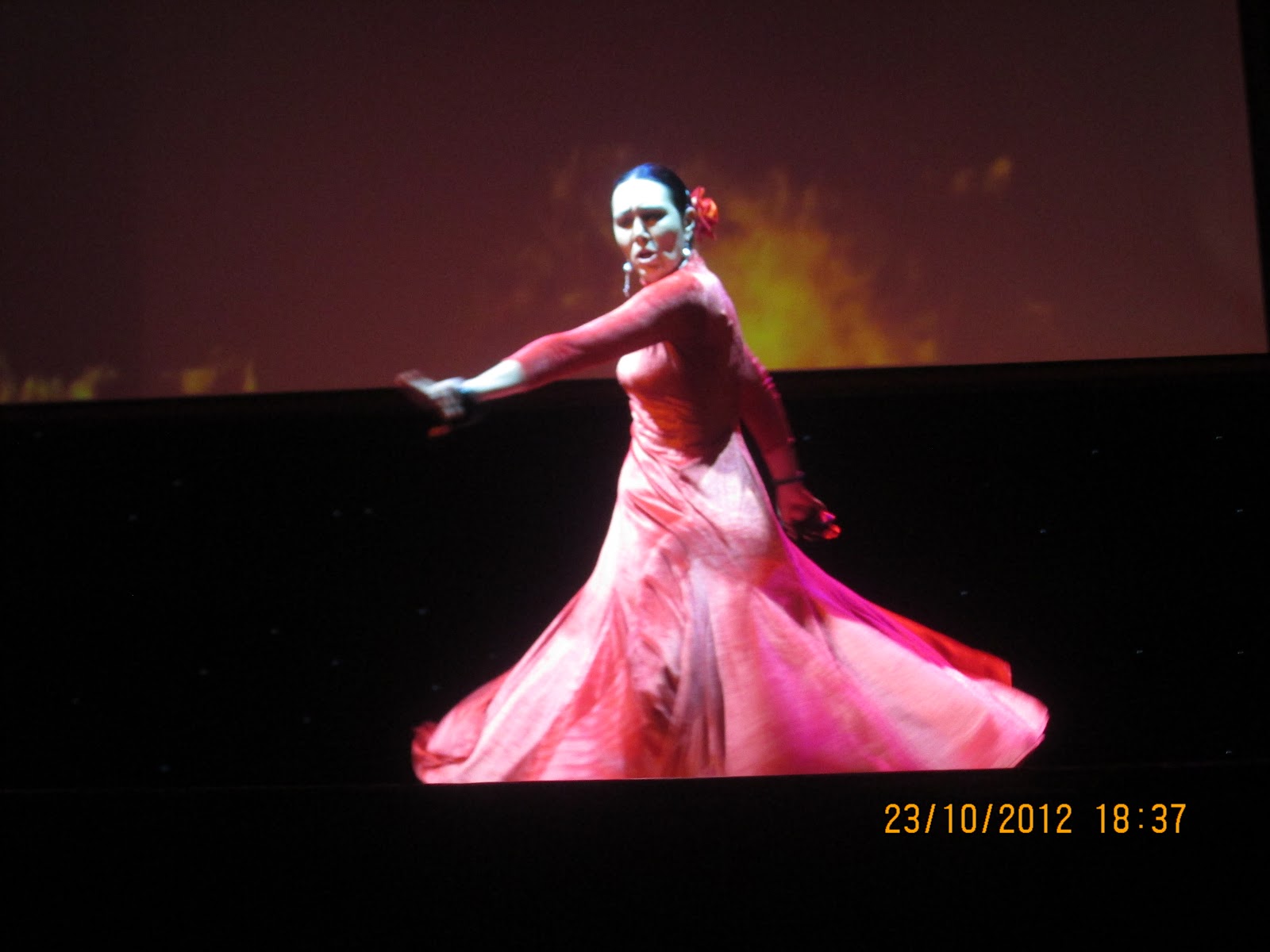
The show opened with a light display which led onto a Renaissance-style flamenco dance. There was one main dancer throughout, who wore a hooped skirt, clog-like shoes and a white net with pom-poms over her hair. The dance was quite slow and restrained compared to modern flamenco. 
The slideshow was pretty poorly operated, but it showed a lot of famous Renaissance art and typical symbols of Spain like oranges and views of Granada as we watched the progression of flamenco styles.
I did not have the shutter speed to capture a still of the whirling Baroque style. The dancer was constantly spinning and winding her arms, dressed in long, black lace. 
It did end strangely as the light people came back on and she threw herself dramatically to the ground like a poorly-acted death scene. That could be the heightened tension emphasised by the Baroque movement, or it could just be Russia.
Opera and dancer whirling large red fans
The programme alternated between dance, opera and instrumental performances. Although the singer was very talented, and actually looked Andalusian, the style didn't vary much and the dance was definitely the highlight of the evening:
Seville flamenco with a shawl
Romantic flamenco - lots of bending and twirling.
I can imagine that to someone not well-acquainted/in love with Spanish culture, the poor organisation of the event could have marred the experience, but the Spanish guitar, stamping and castanets were exactly the hot-blooded sounds I have been missing, along with the novelty of seeing a foreign culture interpreted by an even more foreign culture. As awesome and crazy as Russia is, I'll see you guiris in Andalusia.


Russian Roads and Wimpy English

Natasha, the student I lived with in Kazan', repeated a Gogol quote to me:

'Russia has two problems: stupid mens and roads.'

She related this to me in English so this may not be exactly what the great novelist said, but it still holds true. Kazan's roads were riddled with potholes, uneven cobbles and rubble. Pedestrians picked their way around obstacles as best they could, with some brave (Russian) souls in towering heels, while the cars thudded up and down over holes and tracks for the trams. Even in St Petersburg's diluted part of Russia, they are prone to dig up the road unannounced, but it is hastily built over.

The interesting aspect of Russian roads is the almost total lack of health and safety. In England, roadworks are made totally inaccessible to passers-by, who are shepherded carefully around them by garish plastic buffers, just in case a car nicks them. In Russia, people walk freely through most roadworks, right past active pneumatic drills, across dirt, dug-up cobbles and mud. On the road of our school a giant cavern dug into the pavement was half-heartedly marked with a string of red tape, held in place by one of the giant rocks.

At the moment industrial bags of sand have been emptied across the recently-finished pavement around the corner. A man with a broom intermittently smooths the tracks made by so many Russian feet, but to my untrained eye its purpose is still confusing. I like to think the powers that be are harnessing pedestrians like mules to finish the pavement's surface, so I always walk on that side. Plus it's kind of like being in a sandpit.

I think the reason Russians happily trip across slightly hazardous areas, while in England there would be a lot of literal red tape and several law suits, is because:
a) Russians are not used to mollycoddling. You are expected to use your common sense as you get around and if you hurt yourself, it's your fault. The nanny state is not a problem here.
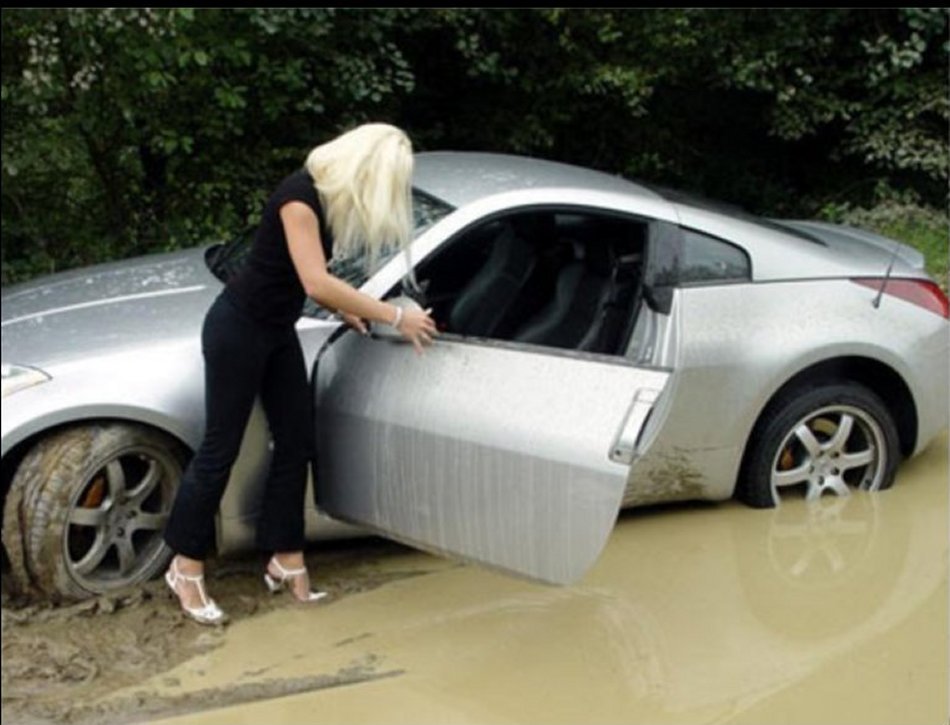
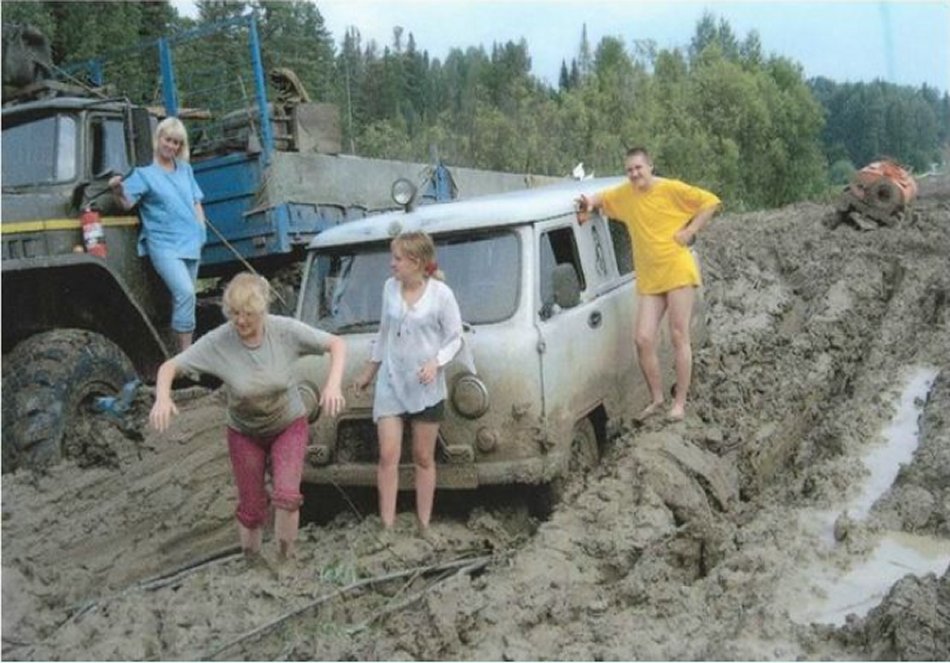
b) Russians are used to a lot worse. Below is what happens to the Lena Highway, or the 'Highway from Hell' every time it rains:
In one "traffic jam", 600 cars were stuck and a woman gave birth right in the public bus she was travelling in. The rescue team was afraid to arrive because the last time they were beaten by those stuck in their cars. In the meantime, they broke the locks on trucks in search of food, warm clothes and fuel.
Sort of makes us look a bit pathetic...
Additionally, pedestrians are largely expected to look out for themselves as legislation heavily favours motorists. When the light is green for the cars, the cars can go. When the light is green for the pedestrians, the cars can also go. Most of them are nice enough to slow down for pedestrians during the pedestrian crossing, but you have to watch out for the odd boy racer/digger. It's disconcerting at first, but after a couple of weeks you happily walk out in front of cars and assume they won't mow you down. I'm a little concerned about keeping this habit when I go back to London.
There is a similar discrepancy with snow. Some Russians we were talking to thought it was a myth that 3 inches of snow grinds London's cogs to a halt. Alina held her hand to her temples and said:

"But sometimes we have it up to here!"

From an outside perspective, it's even more ridiculous that England has the same argument every year about not buying enough grit, that schools and workplaces close and public transport barely runs. The stillness is magical, until the pithy layer of snow turns into dirty slush. It's no wonder Scotland just laughs and wants nothing to do with us. Meanwhile, in Russia...
Speaking of which, the first snow is predicted this weekend. I can't wait.

Monday, 22 October 2012

Udelnaya Market, Pickled Foetuses and a Gift from a Stranger

Yesterday, I was talking to Nastya, one of the Russians who has been employing me. Her response to being told that not all homeless people in London are immigrants who couldn't find work:

"But I thought your government cared about homeless people?"

-made me realise that I am beyond the point of culture shock in Russia, as westernised a city as St Petersburg is.

On Saturday we went to Udelnaya market, Petersburg's largest open-air flea market, seeking Soviet relics and weird Russian behaviour. We were justly rewarded. There are lots of counterfeit products which seems to put the sellers on edge and I even got told:

"Girl, you can't look at everything without buying!" after a minute or so of browsing a stall. I quickly moved on.

I was too intimidated by the shouting Russians and collections of weapons to take pictures. So, I found some pictures on the Internet to give an idea of the market. 
To get to the real gems, you have to walk through rows of metal huts with jumbled piles of clothes, which you can see babushkas expertly sifting through and discarding. There are lots of mannequins with different facial hair scribbled in permanent marker. My personal favourite was the obviously male head with Sharpied eyeliner and lipstick, under a bedraggled wig and a woman's hat.
The market as we saw it looked like this, but busier and slushier. The mud had no effect on the babushkas in man's boots trekking through it to hawk wares or argue over prices. The stalls turned in to ramshackle tables covered in coin collections, decorative spoons, various nuts and tools and the odd statue of "tribal" people in compromising positions.
Products ranged from some lovely jewellery depicting snakes and frogs to a beautiful cabinet with a picture of Stalin in front of an idyllic Soviet peasant sky. There was also a gigantic cast-iron profile of Lenin's head. 

In the ramshackle-table part of the market were a lot of collections of army uniforms, galoshes and helmets. The stalls were often set up like a stage set or someone's attic and we wondered how many of those kept at the back were bullet-ridden war souvenirs.

Towards the end of the market, what looked like the contents of people's attics/a psychopath's shed were laid out on wet cardboard or cloth in the midst of the slush. There were little treasures like battered old suitcases and a miniature teapot which I didn't buy because it was priced at 600r (£12!) and haggling was an arduous prospect. 

One canvas artfully displayed a selection of antlers, with one mounted deer's head being the priciest item. Later on we found a wolverine's skinned face among the broken pieces of a child's doll (all present) and a small pistol.

Weapons were fairly popular there. The shock of seeing the first collection of machetes wore off and our interest was only mildly piqued by the grenades, bullets, rifles and samurai swords laid out for sale. 
Large men in leather jackets toasted the day with thermoses of tea or mugs of vodka as we listened to people enquiring about samovars or loudly sounding a strange wooden horn that sounded like a didgeridoo. 

It is largely Russians who frequent this market - we tried to keep quiet and go incognito as far as possible. The only real signs of tourism are the many little statues of Soviet figures, and the counterfeit Royal Mail jackets hanging on a rack. I have yet to actually see a Russian dressed as a postman.
The Neva - like the Thames but MASSIVE
Earlier this week we finally went to the Kunstkamera museum - the first museum in Russia, which began with the collection of Peter the Great. It's on the bank of the Neva, across from the Hermitage. Although its main exhibitions are about indigenous people from different countries, from Eskimos to Iriquois, its main attraction for tourists is Peter's penchant for pickled foetuses. 

Unfortunately, we didn't find the medieval torture instruments I'd heard so much about. There was a lovely collection of coloured beetles, but it did little to detract from the foetus-induced revulsion. I tried to ease my way into the exhibition by looking at a display about Peter I, my eyes flicking between the items and their descriptions. I suddenly realised that below Peter's portrait was a child's head in a jar. 

After that shock I decided to wander over to the foetal displays. In both cabinets there was also a large fish pinned above the jars. I assume the organisers thought it would blend in. Apparently Peter ordered malformed, still-born infants to be sent over from all over the world, in an attempt to debunk superstitions of monsters and later displayed them as accidents of nature. 
One of the less gruesome displays
There were also some very nice pictures from Tibet, so it's not all doom and preserved limbs.

My week ended in a strange way: last night, as I was walking back from the supermarket, a strange man started telling me that something had fallen behind me. I confusedly wondered if I had dropped something, when his friend smiled, tapped my arm and said:

'Это шутка - It's a joke'. Then as we began to cross the road, his friend held the rose he was carrying out to me and said:

'А это вам - This is for you'
Stunned bag-lady
I thanked him and as I walked home, some boys I passed shouted 'Ах, красивая роза - Ah, beautiful rose!' 

That never happens in England.

Thursday, 11 October 2012

Getting Ill in St Petersburg

It's been raining a lot recently - as in, really heavily for several days. In other news, I am ill, which has made for a fairly miserable time. 

But, from the ashes of my sad, sad days stuck inside watching ridiculous television and trying not to cry rises this riveting post about getting ill in Russia. Huzzah!

Firstly, if you don't want to get sick, don't drink the tap water. That's a given. I don't know exactly how they filter it, but it's not at all enough, it's nasty stuff. Russians don't even drink it. 

Additionally - don't assume that just because one of the hot/cold water dispensers in your corridor dispenses mineral water, that the other one will too. Even if you've been drinking from its hot tap and felt fine. Even if the bottle has a mineral water label. Even if your Turkish roommate drank more cold water than you with no ill effects. If you drink it, you will find yourself vomming out of a moving marshrutka before you can say, "No...pochemu?"
Yellow-tipped water. Also seen shooting from our shower and our sinks
Secondly, call your insurance before you receive any kind of treatment. Luckily, I got this advice before I went down to the American clinic to make an appointment and get a blood test. 

Less fortunate was our friend who went there complaining of what sounds like the same virus as me. She received outstanding service: friendly; a myriad of tests offered, including an x-ray; immediate results, for the low, low price of £330. Payable on site, of course. After an hour on the phone to a doctor with the insurance company, they agreed to pay her back - after 4-6 weeks. Which is super helpful considering that equates to a month's rent and a week's spending.

Her other advice to me was to treat my illness myself with lemon and tea. Unfortunately with my myriad of problems, this is not an option. However, I am drinking this to "treat the virus":
Like a rum-less mojito, or 7Up with mint. So, so refreshing.

There are a lot of misconceptions about the Russian healthcare system. I think when most people picture it, they see this:
Not that I've been in a Russian hospital, but I have been comfortably reassured that they are more NHS than CIS. And as the aforementioned example shows, money will get you everywhar (as well as dokumenty. Go nowhere without your dokumenty).

My insurance company called me back promptly, put me through to their medical team to clarify what was wrong with me (ie, много), and then made an appointment for me at my preferred time at my preferred clinic. 

Contrary to sensible assumption, it seems only the receptionists at the American Clinic speak English. Nevertheless, I managed to successfully navigate my appointment, having preemptively looked up relevant medical terms and my blood test was quick and relatively painless. Although my medicine cannot be prescribed in Russia (so I can't get the insurance company to fork out for that as well), there is a pharmacy within the clinic and my very kind and patient doctor called down to tell them which medicine to sell me and essentially, warn them I was coming.

There were some strange aspects of the clinic - mainly that it has a cloakroom and china lampshades shaped like sycamore leaves - but other than that it's just vast, clean and like a labyrinth. Luckily you get escorted everywhere. Or at least, you do if you appear intimidated and foreign.

I do miss being medically exempt but I was pleasantly surprised that my doctor was informed about symptoms that are usually misdiagnosed and that the nice nurse said soothing things in Russian during my blood test. And I seem to have come away HIV-free! Hopefully.

Wednesday, 10 October 2012

Podarok

Anya, one of my little students (aged 10), gave me this lovely bracelet she'd made me on Sunday. у нее золотые руки - She has golden hands!

Sunday, 7 October 2012

Autumnal Elements of Russian Culture (Mushrooms)

Mushroom Festival
Or, 'Russian Events Which Deviate Massively from the Theme'. Okay, the first one was better.

So, mushrooms play a big part in Russian culture. In the autumn, mushroom gathering is seemingly a standard important event for rural Russians at least. It’s hard to tell whether Russians from urban areas actually seriously partake in the mushroom foraging, or whether they just attend token celebrations like the one I went to on Saturday.

The gathering of mushrooms appears to be a serious event, as you need either specialist insider knowledge or a gribok (mushroom guide), unless you want to poison yourself. Come to think of it, that would be a spectacularly gruesome peasant death...

Nevertheless, our introduction to the mushroom festival began with this:

We knew from the get-go that it would be a solemn affair.

After paying a modest 20r (£0.40), we were greeted by the sounds of music and cheering. The music at this point was of the traditional Russian fare and the first stall we visited had recreated the forest floor on its table:
The people behind the stall, who belonged to some variant of the St Petersburg Mushroom society, were very keen to educate passers-by on the different varieties of mushroom. Very, very keen.
Apparently Russians are initiated into the tradition of mushroom-gathering from an early age:

"I gathered them, I brought them, but who's going to clean them?" #Russianproblems
By this point, we were expecting the festival to be chock full of mushrooms and little else. Then this passed us: 
We were somewhat perturbed by the appearance of a child-sized train with a very menacing-looking driver, but reasoned that such entertainment was still in keeping with the theme. Several feet away, we were met with this:

We concluded that our expectations were misguided. While Russians are for the most part immovable on procedure in a bureaucratic context, they are also absolutely bonkers. The collection of stalls at this event was as wonderfully weird as when my babushka presented with a pasta omelette in an attempt to make me feel more at home, and just as endearing.


There was also a horse and two ponies, along with a goat and an elk with half a horn being fed branches in a makeshift pen with a reindeer tied to it. 

The Ferret Society graciously made an appearance and ferrets tumbled over people and each other.
There were several stalls selling mushroom soup cooked in large cauldrons and saucepans of mushrooms and potatoes fried over charcoal. Among the stalls of babushkas selling wooden combs, woollen vests and eclectic memorabilia decorated with images of Putin or cats were offers of natural medicine involving honey or mushrooms.
Mushroom cakes
"Masculine Strength" honey
I was given a booklet on mushroom medicine which also includes a song about mushrooms and several recipes. This was the highlight of my day until I wandered towards the source of the music, which was turning into pop.

In front of the stage with the live singer, giant mushrooms and a strawberry danced around and chased children.
 However, the actual weird ones were the Russians who joined in. As I stood taking pictures I had to dance around a little so as not to stand out.
My favourite point was the Slavic rendition of Venus by Bananarama, when a new giant mushroom joined the group.
Having had my fill of the madness, I managed to get a picture of this adorable old man sitting by his handful of sycamore leaves as I was leaving.

Although the mushroom-gathering season has passed without our participation, this festival made me ecstatically happy. Russians are just totally mad and carefree in their celebration.

My other favourite tradition is the thick hot chocolate. Granted, this is more of a winter tradition, but I had (drank is not the right verb) my first one in autumn and the weather was still absolute pants. Anyway:
It was impossible to get a picture on reception of my drink because...I was busy drink/eating it. The chocolate is so thick that the waiter brings a glass of water for each person to help wash it down. Luckily our whipped cream helped to thin out the mixture a little - and make it full of delicious calories. Russians definitely know how to do autumn. Naysayers?
Happy 60th birthday Mr Putin!