Monday, 1 October 2012

Bridges, Chekhov and the Children's Embassy

 So I have had a fairly exciting week and a very exciting weekend, which was dampened slightly by the lack of Internet and very literally by the huge amount of rain. Even living in London, I have rarely seen so much water, which pools on the uneven pavements and roads.

Challah, on a pirate party plate. And what of it?
Tuesday dusk marked the start of Yom Kippur, for which I fasted and managed to get some fresh, soft challah from a bakery van in Sennaya Ploshad' for 46r (£0.92). I also broke fast with a double Picnic. I have heard tell of a triple bar but so far this is just a distant legend.

I also joined the State library, which was not the ordeal which we were warned about. Of course they required all our original dokumenty and to take a photo on the spot (a warning about that would have been nice) but otherwise the staff were very helpful, the interior large and intimidating and the doors were incredibly tall and heavy.

This was also on the side of the library
On Friday night we finally got ourselves out to see the rising of the bridges. Having checked the bridge timetable in a guidebook, we arrived with time to spare to see the Palace bridge rise at 1.25 am. Obviously, when we got there at 1.05 am it already looked like this:

It was very pretty nonetheless and as I had my camera, it was fun to experiment with the gap:


There is a tradition in St Petersburg for newly-weds to sail (unidirectional) under the open bridges and kiss for a lucky life. I decided not to over-think the fact that all the boats on the river after the rising of the bridges were large, industrial tankers.

We managed to witness the rising of the next bridge along, from a distance. 

My favourite aspect of the city at night is that all the buildings are beautifully lit from below. We sat right next to the water and the smooth passing of the tankers was incredibly peaceful. Then a drunk man came along and said 'I will [pasu]. Don't run away. Do you understand?', then proceeded to urinate in the river. 'Ohh', we thought, 'You will pisu (piss)'. Then we ran away.

Hermitage and Palace bridge
 As I wanted to take more pictures of the Hermitage at night, we walked around in the drizzle into the square with our cameras.


 It's strange how the Hermitage looks both incredibly beautiful and incredibly spooky at night. In the square, various youths on mopeds raced each other, avoiding the tired-looking horses who slept standing up, waiting for tourists to con.
We also rubbed the feet of the large statues at one of the entrances, for luck, one of many statue-rubbing superstitions in St Petersburg.

It then proceeded to rain A LOT so we abandoned our idea of going to the Church of Spilled Blood and sloshed home. I was especially glad as a friend and I had a meeting at 11am the next day with Nastya, our new boss at the 'Children's Embassy', an extra-curricular English speaking club.

We dragged ourselves out of bed and across town the next day to the British Bakery. It is basically a patisserie with pictures of the Tower of London and English newspaper clippings set into the tables. There is a lot of tea, but it is still served in a glass. I assume this is how French people feel when visiting Maison Paul. We were given all the details about our classes, and I am now teaching two classes (8-10 and 11-13) for four Sundays and possibly working at the 'Detskiy lager' or 'Child camp' in Reading Week. It's less ominous-sounding in Russian.


Saturday evening we went to Baltiyskiy Dom to see The Cherry Orchard by Chekhov. It was a very interesting performance, possibly a new interpretation as Ivan died with a sudden thump on stage and they appeared to have added a new character, Charlotta, whose role was apparently just to be really weird and have a shaggy bowl cut. Our seats were 'behind the armchairs', uncomfortable chairs that I would happily pay more not to sit in next time. However, the acting was wonderful and we understood most of the dialogue, which was a nice surprise.
They also had some models of different upcoming performances. I'm really hoping to see Ward No. 6, above.


With the children and their completed maps last week

On Sunday I took two classes of children. They loved my presentation and the weird things on it, though they were not a fan of Marmite, which I got them to try on its own (revenge for tvorog!). There is an absolute poppet in my first class, who arrived late but exclaimed 'London, I love London! I love Harry Potter! Akh, the Queen!' 

When I showed them the slide about food my family eats and explained that we eat a lot of curry because my grandparents are from India, there was some confusion, even after I explained it slowly in English and finally, in Russian. He held onto my arm and said confusedly in my ear, 'But...my grandparents...are from Russia'.

Nastya told all the children, who we taught last week, before the classes that I didn't understand Russian so they had to speak to me in English. One of the 13 year olds, who has been studying English for six years, replied with a laugh: 'We know'. It was just a coincidence that the good behaviour sticker went to someone else.


Some of my drawings were admired and some were not. For example, 'That doesn't look like a potato!' I tried to explain that potatoes are hard to draw with felt tips at midnight the day before the assignment but children are harsh critics. Nevertheless, this week was really enjoyable and I'm really happy I get to do more teaching. 

I also learnt that the kids all eat strange sandwich combinations for breakfast,  and think that bears are friendly, approachable animals so I'm also learning more about Russia as well as about teaching in a creative, fun way. The best news is that I appoint a 'secretary of the meeting' every lesson so my plan is to leave all the discipline to them. They can let the power go to their heads and I can remain the popular teacher. And if there is a bear attack, I assume the 8 year olds will know what to do.

Sunday, 23 September 2012

Pesky Russians and their Pernickety Language

Russian problems
Russians are very precise. And also complicated and pretty weird. How do I know this? Well, many things clued me in, but a great example is their language. Below is my homework for this week.

Verbs about reading
Surprised? This should be easy: lire, leer, leggere, lesen, לִקְרוֹא (likro). Even Hebrew just has the one verb. Then there’s Russian:

читать – to read. This is the imperfective infinitive...okay, I can handle that.
почитать – to read a bit of
прочитать – to read to the end of
перечитать – to read over
дочитать – to read up to
вычитать  – to take away from a text
вчитаться – to analyse, think about, concentrate on
зачитать – to read to/aloud
зачитаться – to lose oneself in
отчитать – to give an account/report
начитаться – to have enough of reading. Extremely relevant here.

That’s just a taste of Russian linguistic precision, not to mention the conjugation, stress, pronunciation, different prepositions and cases required (not always the same case for the same preposition hahaha).

The real stinker is verbs of motion, otherwise known as VOM. Oh, Russia. Why can’t I simply tell you that I went to the shop, or to France without considering the effort it will take, deciding against talking to you at all and eloping with Spain?


What does Spain have that I don't have? You tell me, Russia...
Spain lets me ir however I want. I don't have to consider the mode of transport, regularity and intentions behind my journey. I also don't need to convey whether my journey was a return trip, whether I went directly to my destination, stopped off, or wandered, or the actual directions my journey took (round? across? along? past? up to? etc...). Once I've figured all this out, I then have to consider the right prefix to put on the right conjugation of the right aspect of the right verb with the right preposition with the right case. 

This alleviates the inadequacy I've been feeling lately, having spent 2 years studying Russian and still being unable to say simple sentences to people. I only just noticed the vast improvement in my Russian when I don't have to use verbs of motion. I'm also now wondering whether I now pay more attention to the details of my journeys, as Russians must with the linguistic influence. 

Don't even get me started on Russian numbers. There is no need to say years as 'In one thousand, eight hundred and forty-sixth year'(prepositional case) or 'On the 3rd of march, one thousand, seven hundred and eighty-second year'(all genitive, thank you) - stop punishing yourselves! Especially as you have to conjugate both cardinal and ordinal numbers according to case and gender. Apparently Russians just avoid this in daily speech, but I have to do it anyway, because...


It's difficult enough learning a language that, imported European words aside, is entirely different from your own. It's difficult to recall words and it's nigh on impossible to guess their meaning without obvious context. This is not helped by the fact that most of their nouns end in some kind of '-ение': '-шение', '-щение', '-чение', '-тение', '-ление', '-мение' and '-нение' aren't easily distinguishable when you're put on the spot.

Also I have to say, the argument that English is difficult because of its strange colloquialism, spelling that differs heavily from the pronunciation of words and multitude of words that have many different meanings, or words that sound the same but are spelt differently, falls kind of flat with respect to Russian. While it may be phonetic, there are many sounds that are alien to English speakers, who then discover that many letters have a completely different sound depending on their stress or position in the word.

 Otherwise, Russia has all the same linguistic traps, as well as grammar that is completely different to other European (Edit: Romantic! DUH) languages. For example, 'угол' - corner and 'уголь' - coal. Or 'пол' - floor, gender, sex, Paul. Even having previously studied Latin only gets you so far.

There is a verb for 'to have', but it's not commonly used. Instead you say 'у меня' - 'to me' + object. There are no words for 'the' or 'a'. If you want to say you don't have something you say 'у меня нет' or just 'нет' (+ genitive, of course) - I have no/There is no. To say 'there is', you use the infinitive of the verb to be, 'есть', which also means 'to eat'. 

If you want to tell the time, you need to remember that you need a different case depending on whether you're using the number 1, 2/3/4, or 5-0. And that's just to tell time by the hour. If you want to be more specific than that (and it's Russian, of course you do) you use a different structure depending on whether it's 1-30 minutes past the hour, or 29-1 minutes to the hour. 

Simple, you say? Not so fast - the ordinal numbers are back! For example, 'ten past five' is translated as 'ten minutes of the sixth hour'. So, not only can I not tell time, I'm going to be an hour late for everything. 


 I haven't even touched upon the many different adjectives divided by gender and hard/soft consonants (different endings, different sounds, doing it all wrong) and conjugated by case and number. Or on the participles that are doubled in number by short/long form - totally necessary to lop off that last syllable in very specific circumstances. 

I will admit that you have to just acclimatise and accept that to speak this language, you have to let go of your surprise at the onslaught of linguistic pitfalls. Much like trying to get used to living in Russia, actually. It's all just very, very different. Nevertheless, I still get the urge to photocopy this rant and liberally distribute it to all the Russians who patronise me when I stumble. That means you, 10 year old girl that I taught today. Four years of English won't help you understand this!


She's still way better than me...

Thursday, 20 September 2012

Peacocks, Georgians and the Real Reason for Banyas

Food>Peacock. Even with that 7ft of tail
The above is a perfect example of what does not happen in Russia. Yes? This is the exact opposite of what I'm going to write about. I say write about, this is mostly just captioned pictures. Relaaaax.

To put it delicately, Russian men are generally less attractive than their female compatriots. To put it more bluntly:
Okay, point made. But really, it's a strange phenomenon. The Russian student I lived with in Kazan' told me that Russian men are 'ugly and stupid' and that Russian girls love Georgians (who were apparently permanently clustered in one bar in that city, but I never investigated further).

As a point of reference, Georgians look like this:
Irakli Kakabadz
Some other guy
There is also a serious shortage of men here. Go into any school, shop, library or museum and a male worker will stand out like a sore thumb, unless they're one of the beefy security guards by the door. 

This explains Russian women's penchant for Western men with Western passports and dressing like this:
Annual high heel race, downtown Moscow
It's not at all unusual to see beautiful women with ugly men, Russian or Western. This was more remarkable in Kazan', but the lack of men means that women are the peacocks - even very attractive ones have to dress up all the time to compete for the rare men. In Russia, beautiful women chase you.

The general consensus among all the foreigners I know is that there is also a big discrepancy between attractive Russian girls and the remaining ones. On first impression, there seems to be no middle ground between:
And:

However, once you've spent some time in Russia and more importantly around some actual Russians, you notice that there is a sliding scale of beauty just like there is in the West. 

As quite a few Russians are staring at us on the street and occasionally addressing us in English when we've been silent, my roommate and I have been trying to decipher what makes a person look Russian - and therefore, what is giving us away.

So far, we've come up with:
  • Large domed forehead
  • Small eyes
  • Flat cheekbones
  • Narrow, long nose
  • Long cleft
  • Big lips
  • Small chin

Some of which can be observed on this polite article. And there was me thinking banyas existed only to cure hangovers...

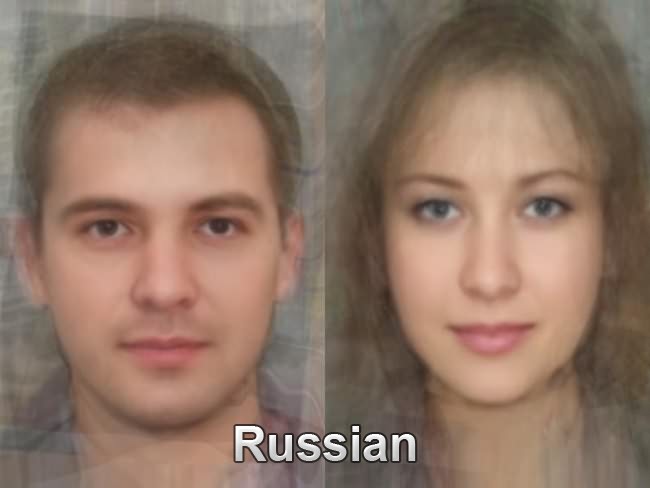
According to the Internet, these are the average faces of Russia:
Fairly accurate
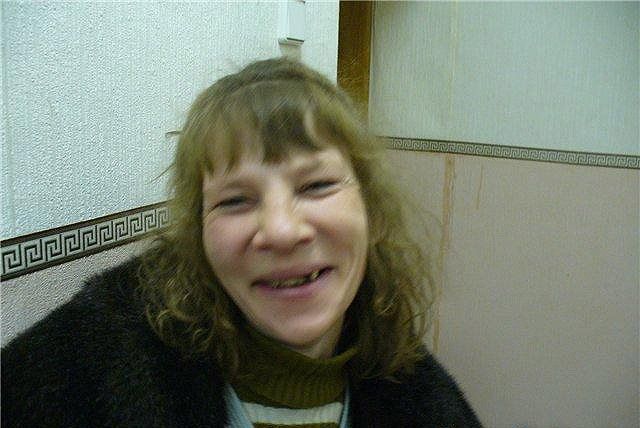
Then again, I'm not sure about this lady...
Just to clarify, I don't spend all my time in Russia peering at the locals like they're some kind of anthropological exhibit. However, I do feel like I might be one and not just because I'm darker than them. 

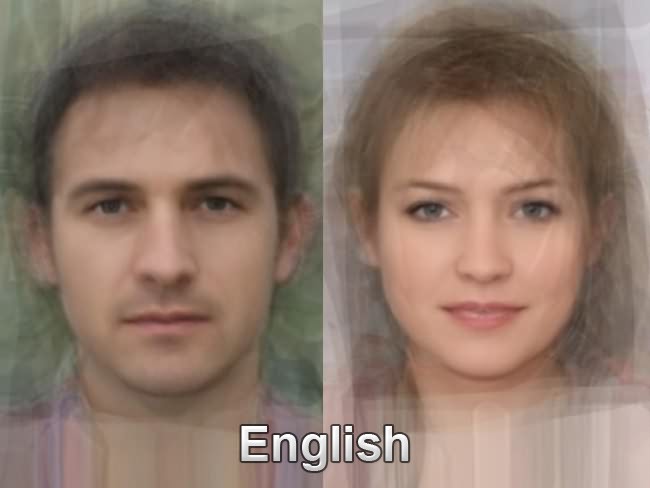
It's definitely an entertaining pursuit if not a worthwhile one, closely examining the integral differences between our countries. And anyway, attractiveness is not a bad stereotype to have. Consider the first Google Image hit for 'English girls':


Okay. Maybe the staring does make sense.


Wednesday, 19 September 2012

Russians Who Have Shouted At Me

It's been a bad 24 hours for Russian relations. Putin is expelling US Aid from the country, aliens have struck again and I seem to have inadvertently made a few people angry. However, with some helpful adjustments, hopefully I won't make these mistakes in future:

Lesson One: When using any kind of automatic machine, have a quick look at the area surrounding it. There just might be a large sign saying THIS MACHINE DOES NOT GIVE CHANGE and you will feel quite silly when the resident babushka who has to open the safe to give you change is tapping it and ranting.

Lesson Two: If in doubt, do nothing and find the nearest friendly babushka. Babushkas are only friendly if you don't piss them off first, and helplessness is much cuter than stupidity.

Lesson Three: Babushkas can hold a serious grudge - as learned by Laundry Babushka's gruffness on our return 2 hours later. Next time I do laundry will be in disguise.

Lesson Four: Pay everything in exact change. Russian cashiers are forever short of change, and very reluctant to part with large sums of it. The best places to cash your 1000r (£20) notes are in supermarkets/large chains - you will get laughed out of the Produkty for having even a 500r (£10) note. Don't even think about it.

Lesson Five: If you can't adhere to Lesson Four, either get good at understanding cashiers (they mumble, a lot) or hold out a selection of shrapnel when they ask you for extra change. It is not fun being told 'No girl, eleven - ten plus one is eleven'. 

Lesson Six: Cyrillic slogan t-shirts can be provocative. However funny 'Say No to Vodka' is (very funny, obviously), even wearing one briefly on laundry day draws a lot of stares and apparently makes you look puritanical rather than ironic and hilarious. It may also cause a drunk to slur at you, '[something I didn't catch] to/for your husband, remember that'. 

Lesson Seven: When using a communal shower, timing is of the essence. If you choose to shower at 10am on your day off, assuming everyone with urgent plans has left already, apparently 10 minutes is your maximum. Remember to lock the door because inevitably a Russian will try to come in, THEN bang on the door to say you're taking too long.

Lesson Eight: If you see a man with a singular large dreadlock, a cowboy hat and boots and a badge saying 'I am against Putin' - avoid, avoid, avoid. This has not been learnt the hard way.

Lesson Nine: Russians like to throw small change at various statues and fountains. This can prove relatively lucrative if you wait around for people to leave (ploy of a lot of babushkas).

Lesson Ten: You are a foreigner, you must acclimatise, even when things seem set up to annoy you. For example, 
  • Nearly every Russian consonant/vowel pronounced completely differently to what seems logical
  • Needing a stamped official document to do the simplest of things, ie buy a dongle, or get a library card.
  • The local hypermarket alternately playing the first 15 seconds of this
with lion roars. Inexplicable? Yes. Annoying? You have no idea...
  • Dill on EVERYTHING from soup to sushi to pizza. The word we thought meant dill, 'zelen'' actually means herbs. It's just used synonymously, which says a lot.
  • The same Russian who nagged you about the shower will turn up in the corridor soon after in a group of people chanting, waving yellow scarves and shouting 'Ooooohhh!' for a lot longer than 10 minutes.
  • Russian drains can't break down loo roll, so you follow the 'urgent request' signs and put it in a bin next to the toilet. A certain 'crew' I know would seriously appreciate this.
  • At any time there could be a brass band outside your window. Expect the unexpected. Otherwise, expect it when you have a hangover.
Nevertheless, I caught myself drinking black tea, eating cold sprats and gnawing on a hunk of bread the other day. Then I realised my idea of going native is an animalistic lack of table manners. Mnye zhal', Russia...

Monday, 17 September 2012

The Russian 'Dusha' in The Window to Europe

Surprisingly microcosmic
The cultural and political capital of Russia has been called both the 'most artificial city in the world' by Dostoevsky and a 'window to Europe' by Pushkin, two fundamental figures in the adoption of the idea of the Russian 'dusha'. 

Most accurately translated as 'soul', the concept of an innate Russian identity originated in Gogol's publication of 'Dead Souls', a reference to landlords' accounting term for 'serfs' as 'souls' - which seems exaggeratedly cold. It's remarkable then, that this variety of Russian nationalism was equally influenced by German Romanticism and serfdom. 
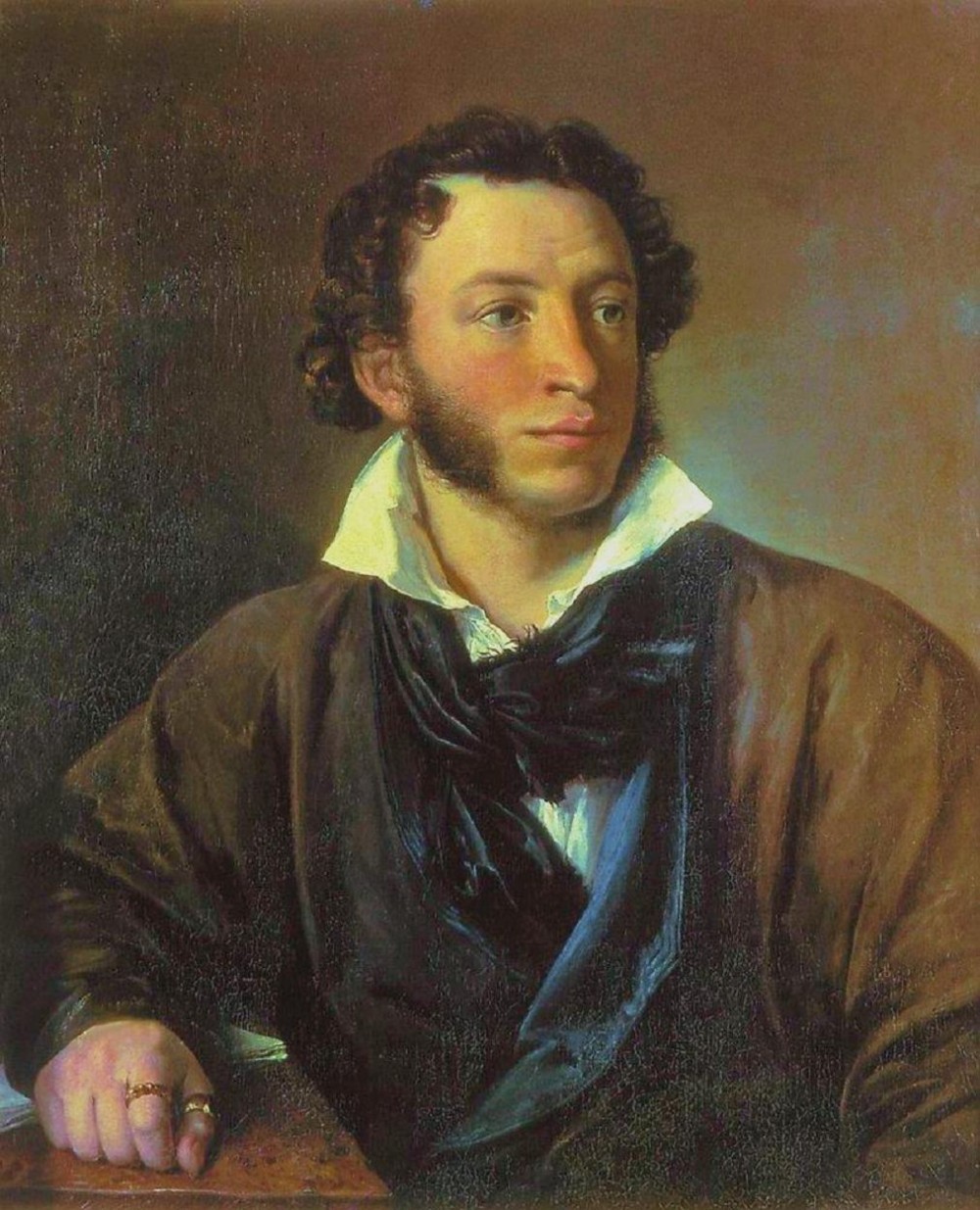
Portrait of A.S. Pushkin by the Romantic artist and former serf, Vasilii Alexandrovich Tropinin
 Slavophilism gained in popularity in the 19th century, in the wake of a society split between those pro-Westernisation and the traditionalists. 

After such progressive leaders as Peter the Great, Alexander I and the famous Francophile Catherine II, who made French the aristocratic language, a revival of Russian nationalism was needed beyond the 'Official Nationality' of Emperor Nicholas I.
Ekaterina II, with various male officials under her feet
Rather than strict adherence to 'orthodoxy, autocracy and nationality', the quest to find the Russian 'dusha', the integral spirit common and unique to all Russians, was a more sensitive nationalism, an attempt to pinpoint what was already tangible.


The very infrastructure of the city is undeniably European (while sadly Russian in its lack of maintenance). You could be forgiven for forgetting that you're not in Paris or Prague among the ornate, pastel-coloured terraced buildings and occasional accordion player.
Due to the many canals, Peter originally intended the main form of transport to be by boat, as in Amsterdam and Venice. This is not the case - Russian marshrutki, tramvai and trolleybusi are the main transports aside from the ornate metro (very deep underground to avoid the layers of swamp - nice one Peter).


It is difficult to overestimate the importance of literature from around the 1840s onwards in the formation of the Russian 'dusha', regarding both the circulation of the concept and its firm establishment in Russian culture. While the city itself looks European, there are widespread homages to both writers and fictional characters throughout the city.


Mikhail Yureevich Lermontov
Fyodor Mikhailovich Dostoevsky
Mayor Kovalev's nose - a character from Gogol's famous short story, 'Nose'
Alexander Sergeevich Pushkin, head of the Russian dusha (and he knows it)
The arts in general are at the forefront of modern Russian life. At the moment, an operatic interpretation of Evgeniy Onegin is being performed at the Mikhailovsky Theatre, a poema of Pushkin linked to the protagonist in Medniy Vsadnik, the epic poem about Peter the Great and St Petersburg. 

Additionally; ballet, opera, classical music performances are all frequented not just by the highly educated elite but beloved by a significant proportion of Russians (in an already large population). Unlike Westerners, Russians are well-versed in the creative fruits of their country, particularly literature, by the time they leave school. 

It is hardly a secret that under the Soviet Union, which emphasised a delineated Russian identity, there was an absolute rejection of the 'bourgeois' adoption of European customs/languages - and obviously travel was almost impossible. The city's saintly namesake, who held the key to (European) heaven makes the political changes even more pertinent.

I find modern Russia a pastiche of strong traditions of orthodoxy, palaces, Soviet architecture and memorials, alongside a new influx of European brands, chains and cuisine; hence the multitude of dill-coated sushi in all Russian cities. 

Kazan' Cathedral
Church of the Saviour on Spilled Blood: so no one can walk on the assassination site. Look familiar?
At the moment, there seems to be an attempt to Russify certain English things that have been adopted. For example, Russians seem to be keen to distinguish between 'Inostrannie slova' (parlament, restoran, taksi) and their Russian equivalents. 

Although us English have no problem adopting foreign terms as our own, I think this is linked to a)the many different invaders who have colonised us and bastardised our language and b)the lingering imperial sense of linguistic superiority - ie, "I will say 'café' on a regular basis, but refuse to learn French."

Mikhailovsky gardens. Russian: 'Urgent request - don't walk on the grass!' 
There are also some commercial examples of this: as any Westerner in Russia will tell you, the closest you can get to a normal flavour of crisp is 'green onion'. Others include 'sour cream and dill', 'dill and cucumber', 'sour cream and mushrooms' and 'crab' (the living worst: tastes like moist, mushy crab).
Vom
An example more of rather nouveau riche taste than russification (classic English snobbery from me) is the decoration in the nice part of town. One particular street off Nevsky Prospekt, 'Malaya Sadovaya' is a wonderful mix of ostentatiously proud architecture and fake grass. 


I definitely thought these were real
They also have some statues in line with the quaint Petersburg interactive traditions - my favourites commemorate the role of cats post-World War II in fighting the rodents.
Pretty proud kitty
People throw kopecks at their sitting for good luck
Cannot remember who this is - but rubbed his nose and sat down for luck
I would argue that modern St Petersburg has elements of Petrine Euro-focused policy about it. With Russia righting itself after years of Communist dictatorship, it is natural to look to previously outlawed Western commerce. Still, a lot of people work 7 days a week and there is a flat 13% tax rate for everyone, regardless of income. 


Although St Petersburg is known for being not exactly welcoming to minorities, it is certainly an international city. This lovely artist above was chatting to some tourists who were admiring his work in a mix of Chinese and English, telling them that it was cloudy when he started painting the church so his rendition was slightly different from the reality.

Nowadays rather than providing a window onto European 'heaven', St Petersburg seems to me to be a gentle introduction to the previously alien and totally mysterious expanse that is Russia. 
Attempt to provide a more thematic post turns me into a pretentious dryballs. Pity the fool who has to read my essays...